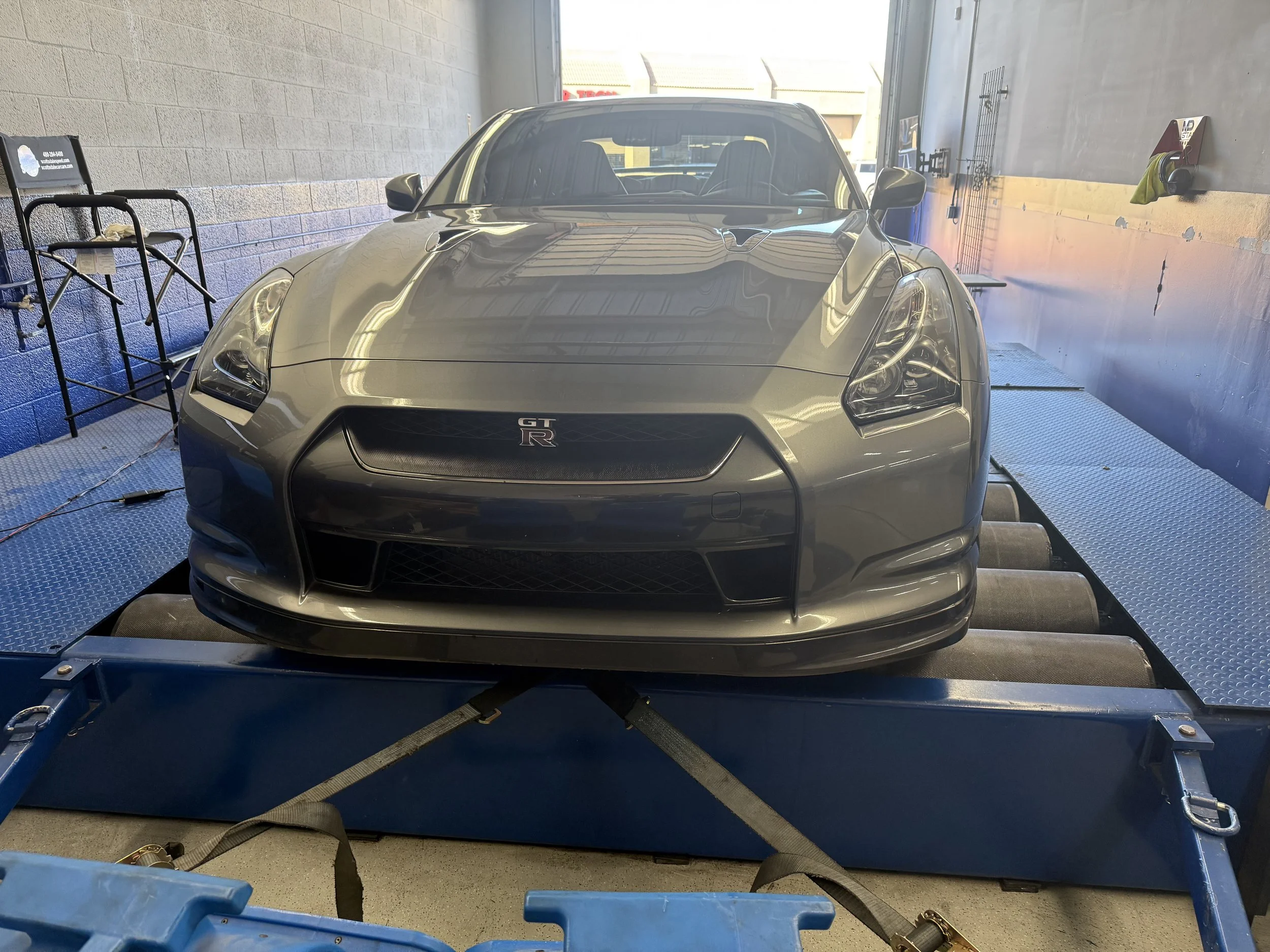
AWD dyno testing · Custom ECU calibration
Custom ECU & Dyno Tuning in Scottsdale, AZ
Get the most appropriate performance and streetability from your build. Scottsdale Car Care & Speed Shop provides vehicle-specific calibration using our in-house AWD Mustang Dynamometer, professional data logging, and HP Tuners software.
Illustrative display. Actual channels and results vary by vehicle and platform.
Why tune on a dynamometer?
Make changes with data—not guesswork.
A chassis dynamometer allows the vehicle to operate under controlled load while the tuner monitors power, torque, fueling, timing, temperatures, boost behavior, and other available channels. That measured process helps us evaluate the complete combination rather than relying on a generic file or a single peak number.
Understand the starting point
Measure current output and review operating data before deciding what should change.
Match the tune to the build
Account for compatible hardware, fuel, modifications, transmission behavior, and intended use.
Confirm the result
Repeat testing helps show whether changes improved power delivery and operating behavior.
Dyno and calibration services
The right session for the vehicle.
Not every car needs the same kind of appointment. We begin with the platform, current modifications, fuel, condition, and goal so the session can be scoped appropriately.
Contact us before purchasing hardware or arriving with an unfamiliar platform. ECU access, licensing, unlock requirements, software support, and tuning availability vary by vehicle.
Baseline dyno testing
Document wheel horsepower, torque, and available operating data without creating a new calibration.
Custom ECU tuning
Develop and verify a calibration for compatible street, performance, or competition applications.
Post-modification calibration
Recalibrate compatible vehicles after airflow, fueling, camshaft, forced-induction, or related changes.
Diagnostic dyno testing
Reproduce load-related concerns in a controlled environment when dyno testing is appropriate.
Transmission calibration
Address supported shift behavior, torque management, and related transmission parameters.
Build consultation
Review the combination and goals before parts are selected or a tuning session is scheduled.
Popular platforms
From American muscle to European performance.
Our shop works with a range of naturally aspirated and forced-induction combinations. Exact software, ECU access, unlock procedures, and calibration availability must be confirmed for each vehicle.
Ford Coyote
Mustang and F-150 applications across Gen 1, Gen 2, and Gen 3 combinations, including supported bolt-on, supercharged, turbocharged, and fuel-system configurations.
GM LS & LT
Camaro, Corvette, Silverado, restomod, and swap applications with supported camshaft, cylinder-head, intake, exhaust, fueling, and forced-induction combinations.
Mopar HEMI
Supported Challenger, Charger, RAM, and related HEMI applications, including naturally aspirated and forced-induction builds. ECU unlock requirements vary by year and controller.
Euro & exotic
Selected Audi, Volkswagen, Porsche, AMG, BMW M, and exotic applications. Contact us with the VIN, ECU details, and modification list so compatibility can be confirmed.
How the process works
A measured path from intake to results.
The exact workflow changes with the platform and job scope, but every successful session starts with preparation and finishes with verification.
Review
Confirm the vehicle, modifications, fuel, software support, mechanical condition, and goals.
Inspect
Check readiness and identify visible mechanical concerns that could make dyno operation unsafe.
Test & calibrate
Collect baseline data, make supported adjustments, and evaluate the vehicle under controlled load.
Verify
Review final data, discuss results and limitations, and identify any appropriate follow-up work.
Before your appointment
A healthy vehicle tunes better.
Dyno tuning is not a substitute for mechanical repair. Existing misfires, leaks, overheating, low fuel pressure, worn plugs, poor compression, boost leaks, or wiring problems should be corrected before calibration.
Fuel matters.
Arrive with the agreed fuel in the tank. Do not switch octane or ethanol content without discussing it with the tuner first.
- Provide a complete and accurate modification list
- Disclose existing warning lights or drivability problems
- Verify fluids, tires, belts, hoses, and cooling system condition
- Repair exhaust, vacuum, intake, and boost leaks
- Use spark plugs appropriate for the combination
- Confirm the battery and charging system are healthy
- Bring keys or controllers required for adjustable hardware
- Remove loose items and confirm wheel-lock keys are available
Common questions
Dyno tuning FAQ
How much horsepower will my vehicle gain?
There is no responsible universal number. Gains depend on the platform, current calibration, modifications, fuel, mechanical condition, environmental conditions, and operating limits. A baseline run and vehicle-specific review provide a better foundation than a promised number.
Can you tune an otherwise stock vehicle?
Possibly, depending on the platform and the goal. Some stock vehicles respond meaningfully to calibration, while others may not justify the cost. Contact us with the year, make, model, engine, transmission, fuel, and intended use.
Do you tune all makes and models?
No single tool or shop supports every controller. Compatibility depends on ECU and transmission-controller access, licensing, software, unlock requirements, and our experience with the platform. We confirm support before scheduling.
What is the difference between a dyno pull and a tune?
A baseline dyno session measures performance and available data without necessarily changing the calibration. A tuning session includes calibration work, licensing where applicable, iterative testing, and verification. The required time and price are different.
Can you tune a car with mechanical problems?
Mechanical or electrical faults generally need diagnosis and repair first. Attempting to tune around a failing component can hide the real problem, waste dyno time, or risk damage. Our repair and diagnostic capabilities allow us to identify an appropriate path forward.
Is dyno tuning safe?
Dyno operation places the vehicle under controlled load and carries inherent mechanical risk, especially with modified or high-output vehicles. Careful inspection, proper strapping, ventilation, monitoring, and responsible operating limits reduce risk but cannot eliminate it.
Tell us about the build
Start with the vehicle, modifications, fuel, and goal.
Send us the year, make, model, engine, transmission, complete modification list, fuel type, current issues, and intended use. We’ll confirm platform support and recommend the appropriate appointment.
Scottsdale Car Care & Speed Shop
9550 N. 90th St., Building D101 · Scottsdale, AZ 85258
Monday–Friday · 8:00 a.m.–5:00 p.m.